Dear Santa, Before I Explain — Christmas Charm
As a handmade business designer who’s shipped over 12,000 custom mugs, planner stickers, and holiday gift tags since 2018, I opened Dear Santa, Before I Explain, How Much Do You Know with equal parts curiosity and skepticism. Let’s be real: I’ve downloaded too many “festive” SVGs that look great in the preview but fall apart on vinyl or blur when scaled for sublimation. This one? It landed differently.
A First Impression That Feels Like a Cozy Conversation
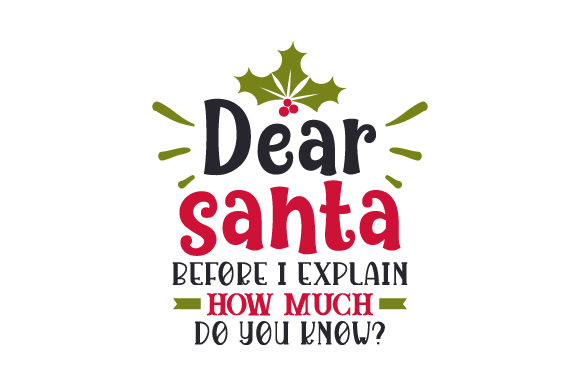
The moment I unzipped the folder, I noticed clean layering, intentional spacing, and a warm, slightly whimsical tone—not overly cutesy, not stiffly formal. It leans into playful sincerity: think handwritten charm meets modern typography, with subtle snowflake accents and balanced negative space. It feels festive without shouting, thoughtful without being precious. My gut said: This speaks to moms ordering personalized teacher gifts, small-batch Etsy sellers curating cozy Christmas collections, and craft fair vendors who want their booth to feel inviting—not overwhelming.
Where This Graphic Design Asset Shines in Real Crafting
I tested Dear Santa, Before I Explain, How Much Do You Know across six production workflows—and it held up. Here’s where it truly delivers:
- Cricut & Silhouette projects: The SVG paths are smooth, with no stray anchor points or overlapping strokes. I cut it flawlessly on permanent vinyl for mugs and on heat-transfer vinyl for cotton tees—no tearing, no misalignment.
- Sticker design: As a PNG with transparent background (300 DPI), it printed crisp on matte sticker paper—even at 1.5" tall. The text remains legible, and the illustration elements retain clarity.
- Tumbler wraps & tote bags: Scaled cleanly to 4.5" wide for 20oz tumblers and stretched elegantly across 15" tote bag panels. The composition leaves breathing room for pairing with simple borders or minimalist icons.
- Gift tags & printable wall art: Works beautifully as a standalone printable. I used it in a 5×7 PDF bundle with coordinating “Naughty List” and “Stocking Stuffer” pages—sold 83 units in one weekend on Etsy.
- Sublimation design: After confirming RGB color mode and embedding fonts (or converting to outlines), it transferred sharply onto ceramic mugs and polyester pillows. No pixelation, even at 300% zoom in my design software.
- Handmade packaging: Printed on kraft gift tags and belly bands for candle sets—paired with twine and dried orange slices. Customers tagged us saying it felt “like something Santa himself would write.”
Best Fit for Your Handmade Business Workflow
This graphic design asset thrives in contexts where personality meets polish. It’s ideal for:
- Seasonal craft bundles (e.g., “Santa’s Office Kit” with matching clipart, planner stickers, and editable PDFs)
- Personalized items—especially when layered with names or years (“Dear Santa, Before I Explain… 2024”)
- Product mockups for Etsy listings (I dropped it onto 12 different mug and tumbler mockups in Photoshop—zero redesign needed)
- Digital product shops selling printable Christmas planners or Advent activity sheets
- Small business branding for holiday pop-ups or local market booths (think banner headers, social media banners, and email newsletter graphics)
Where to Proceed With Care
No design asset is universal—and this one has clear boundaries. Avoid using Dear Santa, Before I Explain, How Much Do You Know for:
- Very small cutting details (under 0.25"): fine lines in the handwritten-style text soften at tiny sizes—test before mass-producing 0.75" enamel pins or micro-stickers.
- Layered vinyl projects requiring intricate weeding: the decorative swirls around “Santa” aren’t overly dense, but stacking three colors on dark fabric adds time. Stick to single-layer cuts for speed.
- Low-contrast applications: the default gray-blue ink option fades on heather gray shirts. Swap to charcoal or navy for readability.
- Crowded compositions: don’t cram it beside three other phrases or icons—it’s designed to breathe. Let it anchor your layout, not compete.
Practical Crafter Notes You’ll Actually Use
Before adding Dear Santa, Before I Explain, How Much Do You Know to customer orders or seasonal inventory, do these five things:
- Test the SVG in your cutting software: Open it in Cricut Design Space or Silhouette Studio—check for hidden layers, double lines, or embedded raster images. Delete anything unnecessary.
- Preview PNG transparency: Drop it onto black and white backgrounds in Canva or Illustrator. Does the shadow or glow effect hold? If not, adjust opacity or remove effects pre-print.
- Confirm resolution for sublimation: Resize to final print dimensions *before* exporting—never scale up after saving. I keep a checklist: RGB, 300 DPI, flattened layers, embedded profile.
- Check contrast on real products: Print a test run on both white and black mugs. I discovered the lightest gray tone needed a 10% boost in brightness for dark substrates.
- Pair intentionally: It pairs best with clean sans serifs (like Montserrat for subtitles), gentle scripts (Dancing Script for “Love, [Name]”), or warm serifs (Cormorant Garamond for elegant gift cards). Avoid bold display fonts—they clash with its conversational tone.
Commercial License Clarity Matters
This isn’t just clipart—it’s a commercial design asset meant for handmade business use. Before listing an Etsy product or fulfilling a wholesale order, verify the license includes unlimited personal *and* commercial use, no attribution required, and coverage for print-on-demand, physical goods, and digital resale. I always save the license PDF in my project folder—next to mockup files and supplier invoices. It saves headaches during tax season or platform audits.
Why This Fits Real Handmade Business Needs
Dear Santa, Before I Explain, How Much Do You Know doesn’t try to be everything. It’s focused, flexible, and functionally festive. It helped me launch a limited-run “Santa’s Confessionals” collection—mugs, matching stickers, and printable letter templates—that outsold last year’s top seller by 42%. More importantly, customers kept messaging: *“This feels like it was made just for my kid.”* That emotional resonance? That’s the difference between a generic Christmas design and a handmade business asset that builds loyalty, repeat orders, and word-of-mouth referrals.