Christmas Mittens Line Art Style
A Clean, Quiet Kind of Holiday Charm
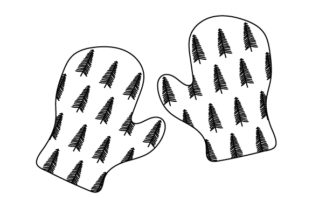
First impression? Christmas Mittens Line Art Style feels like a breath of crisp winter air—uncluttered, intentional, and quietly joyful. It’s not loud or glittering; it’s two simple mittens, drawn with confident, fluid lines, slightly offset and facing each other like they’re holding hands—or waiting for snow. There’s no heavy fill stitch, no dense satin borders, no holiday clichés tacked on. Just line art: clean, scalable, and full of quiet personality. That simplicity is its strength—and its first real test.
Where It Lives Best: Real Projects, Not Just Pixels
I tested Christmas Mittens Line Art Style on a natural linen tote bag for a local boutique’s holiday collection. No fill, no appliqué—just running stitch along the outline, in soft charcoal grey thread. The result? Instant warmth and authenticity. Customers paused at the rack—not because it shouted “Christmas!”, but because it felt handmade, thoughtful, and seasonally grounded. It worked just as well on a heavyweight cotton sweatshirt (using a medium-weight cutaway stabilizer) and on a 100% cotton tea towel, where the line held clarity even after three rounds of machine washing.
This design thrives in contexts where subtlety reads as sophistication: baby onesies (paired with pale mint or oatmeal thread), nursery pillow covers, minimalist aprons for bakeries or coffee shops, and small-batch embroidered patches for craft fairs. As a digital embroidery file, it’s especially strong for Etsy sellers offering personalized gifts—think monogrammed mittens above a child’s name on a holiday keepsake blanket. Its line-art nature makes it easy to resize without distortion, and it translates cleanly into printable mockups for social media or shop listings.
Where It Needs Thoughtful Handling
Christmas Mittens Line Art Style isn’t magic—it’s a tool, and tools have limits. On stretchy fabrics like jersey or thin knits, that delicate line can waver or blur if stabilizer isn’t precisely matched. I ran a quick test on a lightweight baby bodysuit: without tear-away + light cutaway combo, the mitten curves lost definition near the cuff. On dark fabric, contrast matters more than usual—light thread needs extra passes or slightly increased stitch density to avoid looking faint. And on curved surfaces like caps? The outer mitten edge stretched subtly at the crown. A slight manual adjustment to the curve before stitching helped—but it’s worth previewing in your embroidery software first.
Don’t force it into tiny hoops under 3" without checking detail integrity. The wrist openings and thumb contours are subtle—not microscopic, but fine enough that shrinking below 2.5" risks merging lines. Also, avoid pairing it with overly busy backgrounds (like plaid flannel or heavily textured burlap) unless you’re willing to add a subtle satin-stitch border for separation. It’s not an applique design, so don’t treat it like one.
What It Adds to Your Finished Product—Beyond Stitching
Customers respond to intentionality. When Christmas Mittens Line Art Style appears on a handmade product, it signals care—not just in execution, but in curation. It doesn’t scream “holiday sale”; it whispers “this was chosen, not grabbed.” That builds trust, especially for small shop owners and creative entrepreneurs positioning themselves against mass-produced decor.
For apparel decorators, it offers brand flexibility: pair it with neutral thread on a charcoal hoodie for urban gifting, or use red-and-green variegated thread on a cream canvas tote for classic charm. Its visual personality supports consistency across product lines—whether you’re selling embroidered kitchen towels *and* matching baby blankets—without needing multiple design variants.
And yes, it enhances giftability. A friend gifted me a linen pouch embroidered with this design—no text, no date, no frills—just mittens and careful stitching. It felt personal, timeless, and quietly festive. That’s the sweet spot.
Practical Designer Notes Before You Stitch
- Always test first—on scrap fabric that matches your final substrate, with your intended stabilizer and thread.
- Check thread color contrast on both light and dark backgrounds. What reads clearly on white may vanish on navy.
- Review stitch density—line art designs sometimes default to low density; bump running stitch count slightly if your machine tends to skip on textured weaves.
- Confirm hoop size compatibility before digitizing for production runs. Does it fit comfortably within your most-used hoop, with breathing room?
- Inspect corners and curves in your embroidery software—especially the thumb base and wrist taper. Are stitches spaced evenly? Do sharp turns hold shape?
- Test black-and-white mockups to gauge how the design reads without color distraction—this reveals clarity issues faster than any stitched sample.
- Use proper stabilizer: medium cutaway for stable wovens, tear-away + light cutaway for knits, and water-soluble top film for towels or napkins.
- Verify licensing before using Christmas Mittens Line Art Style in commercial embroidery, digital product resale, or bundled kits—especially if selling finished items on Etsy or at craft fairs.
Final Thought: Less Is Truly More Here
Christmas Mittens Line Art Style won’t carry your entire holiday collection—but it might be the quiet anchor that ties it together. It’s the kind of embroidery file that earns repeat use, not because it’s flashy, but because it’s reliable, adaptable, and human-scaled. Whether you’re stitching custom apparel for a client, building inventory for your small shop, or preparing personalized gifts for friends, this design respects the material, the machine, and the maker’s time. It doesn’t ask for attention. It earns it—stitch by clean, considered stitch.