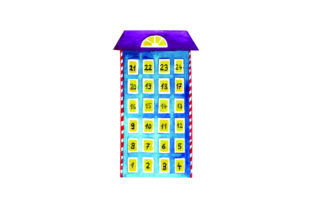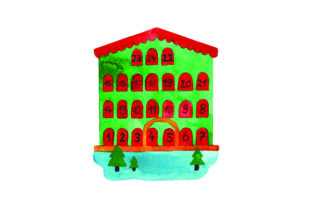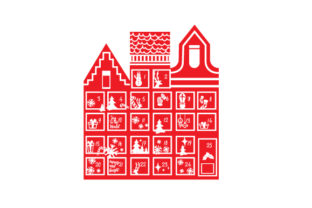
Advent Calendar Canal Houses
A Designer’s First Glance: Charming, Compact, and Quietly Detailed
Opening Advent Calendar Canal Houses feels like flipping through a hand-illustrated Dutch postcard—soft-edged, storybook-cozy, and unmistakably festive without leaning into cliché. It’s not a row of identical rectangles with numbered doors; instead, it’s a staggered cluster of miniature canal houses, each with its own roofline, shutter detail, and subtle window variation. The layout flows diagonally, creating gentle rhythm rather than rigid symmetry—a smart choice for embroidery where visual breathing room matters. As a designer who regularly adapts holiday motifs for real-world products, I immediately sensed its quiet versatility: this isn’t just decoration—it’s a narrative anchor. It invites stitching, yes, but more importantly, it invites *recognition*. People see Amsterdam, they see tradition, they see handmade care.
Where This Design Truly Shines in Real Projects
I tested Advent Calendar Canal Houses on a natural linen tea towel first—no frills, no filters. The result? Crisp, legible, and warmly nostalgic. That’s the sweet spot: it performs beautifully on medium-weight woven fabrics where stitch definition holds and texture supports rather than competes. On a heavyweight organic cotton sweatshirt, the design retained its delicate charm without looking lost or overwhelmed. As a tote bag design, it centered perfectly above the side seam—neither too busy nor too sparse. For baby embroidery, I scaled it down slightly (within safe limits) and stitched it onto a muslin swaddle blanket; the simplified architecture translated well even at 85% size, and parents responded strongly to its gentle, non-cutesy personality.
It also works elegantly as an embroidered patch—especially when backed with twill or felt. The clean outlines and modest fill areas make it stable across laundering cycles, and the lack of ultra-thin satin-stitch borders means fewer snag risks on aprons or kitchen towels. Etsy sellers will appreciate how easily it slots into boutique branding: imagine it stitched on a set of matching oven mitts and dish towels for a “Dutch Holiday Kitchen” collection—or as a subtle accent on the hem of a wool-blend scarf. It doesn’t shout; it invites closer looking. That kind of restraint builds customer trust, especially among buyers seeking thoughtful, handmade product over mass-produced noise.
Where to Proceed With Thoughtful Attention
Like any well-intentioned design, Advent Calendar Canal Houses has boundaries—and respecting them is what separates a polished finished product from a rushed misfire. Avoid using it on highly textured fabrics like bouclé or thick terry cloth unless you’re willing to double-stabilize and reduce stitch density manually. On stretchy knits (think lightweight t-shirts or baby onesies), test thoroughly: the diagonal composition can pull subtly if stabilizer choice or hooping tension isn’t dialed in. Dark fabric demands careful thread color selection—those pale window highlights vanish if your off-white thread lacks enough contrast. And while the design avoids micro-detail, the tiny door numbers and shutter lines do require decent hoop size and sharp needle work; don’t force it into a 3" x 3" hoop unless you’ve verified every element clears cleanly.
Caps and curved surfaces are possible—but only with careful placement and possibly light digitizing tweaks. The topmost house tends to wrap awkwardly over a crown seam unless positioned low on the front panel. Also, avoid layering it directly over seams or darts without testing: dense fill stitches near stress points can stiffen movement or encourage puckering over time. If you're planning commercial embroidery—say, for a local café’s holiday staff aprons—confirm that all small elements (like chimney details or rooftop accents) remain legible after washing. Clarity = longevity = repeat customers.
Design Notes Every Embroidery Professional Should Check
- Always stitch a test run on scrap fabric that matches your final substrate—not just color, but weight, weave, and stretch.
- Review stitch density before sending to machine. Overly dense fills on small houses may cause fabric distortion, especially on lightweight cotton.
- Inspect corners and joins in your embroidery software: look for unnecessary jump stitches or underlay gaps that could show on light backgrounds.
- Compare mockups in black and white—this reveals contrast issues faster than color previews ever will.
- Use cutaway or tear-away stabilizer appropriately: cutaway for knits and unstable weaves, tear-away for crisp linens and cottons.
- Verify licensing terms before selling finished items or listing digital embroidery files—commercial use isn’t automatic, even for holiday designs.
- Check thread color harmony across your palette: warm ivories and slate blues read better than stark whites or neon accents against the canal house aesthetic.
Why This Design Builds Value—Not Just Visuals
What makes Advent Calendar Canal Houses more than just another Christmas machine embroidery design? It carries intention. Its scale implies care—not haste. Its architectural theme suggests craftsmanship, not trend-chasing. When stitched onto a personalized gift—say, a pillow cover for a newlywed couple who honeymooned in Amsterdam—it becomes memory made tactile. For craft business owners, that emotional resonance translates directly to perceived value and willingness to pay a premium. Customers don’t buy pixels; they buy meaning, cohesion, and proof of attention. This design delivers that quietly, consistently.
It also plays well across platforms: as a printable mockup for your Etsy listings, it reads clearly at thumbnail size; as part of a cohesive holiday collection, it pairs effortlessly with minimalist trees or monochrome stars—not competing, complementing. And because it avoids overt religious or commercial iconography, it fits broader gifting contexts: corporate holiday gifts, teacher appreciation, wedding welcome baskets, or even small-batch nursery decor.
In short, Advent Calendar Canal Houses earns its place not by being flashy, but by being *reliable*—a rare quality in holiday embroidery files. It stitches true, photographs well, scales thoughtfully, and stays memorable without demanding attention. That’s the mark of strong design assets: they serve the maker, honor the medium, and resonate with the person holding the finished product.